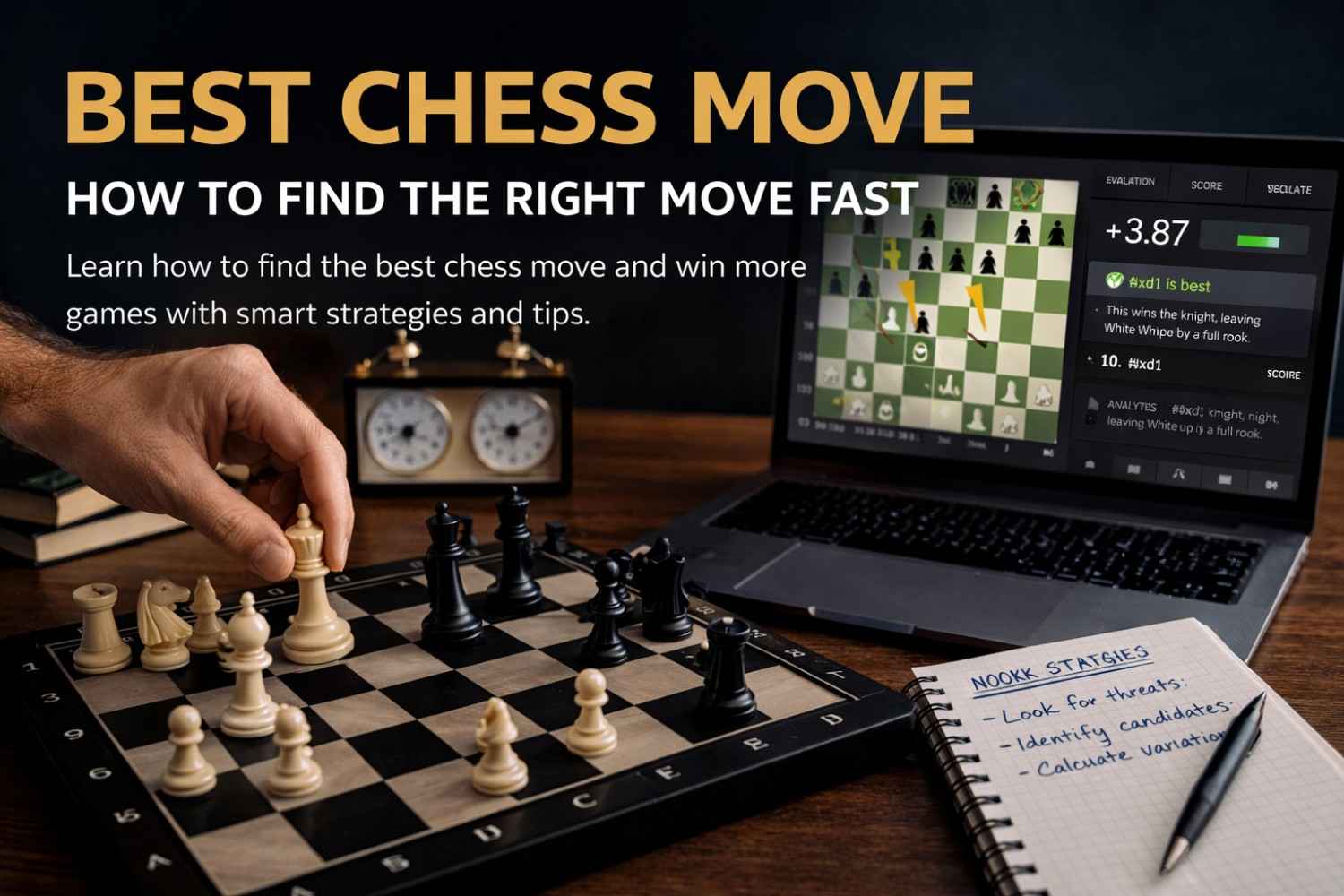
In chess, every move tells a story. Some moves build quiet pressure, others unleash devastating attacks. But every player — from beginner to grandmaster — asks the same question at some point:
👉 What is the best chess move?
The truth is, there is no single “best move” in chess that works in every situation. Instead, the best move depends on the position, your strategy, and your understanding of the game.
In this guide, we’ll explore how to find the best move, improve your decision-making, and think like a stronger chess player.
🧠 What Does “Best Move” Mean in Chess?
A “best move” is the move that gives you the strongest possible advantage in a given position.
This could mean:
- Winning material (capturing pieces)
- Improving your position
- Defending against threats
- Setting up a future attack
Sometimes, the best move is aggressive.
Other times, it’s quiet and strategic.
🎯 Why Finding the Best Move Is Important
Choosing the right move can:
- Turn a losing game into a win
- Prevent mistakes and blunders
- Improve your long-term strategy
- Increase your chances of checkmate
Chess is not about random moves — it’s about purposeful decisions.
🔍 Step-by-Step Process to Find the Best Move
Strong players don’t guess. They follow a process.
🔹 1. Check for Threats First
Before thinking about your move, ask:
👉 What is my opponent threatening?
Look for:
- Attacks on your king
- Hanging pieces (undefended pieces)
- Tactical threats
If you ignore threats, even the “best move” won’t save you.
🔹 2. Identify Candidate Moves
Instead of thinking randomly, narrow it down.
Ask:
- Can I attack something?
- Can I improve my position?
- Can I defend better?
Usually, strong players consider 2–3 good moves, not 10.
🔹 3. Calculate Variations
Now imagine the future.
For each candidate move:
- What will my opponent do next?
- What will I do after that?
Even a short calculation (2–3 moves ahead) can reveal hidden dangers.
🔹 4. Evaluate the Position
After calculating, compare outcomes:
- Who has better control?
- Who has a safer king?
- Who has more active pieces?
Choose the move that gives you the best position.
🔹 5. Trust Your Decision
Once you’ve analyzed:
👉 Commit to the move
Doubt and hesitation often lead to mistakes.
🧩 Types of “Best Moves” in Chess
Not all best moves look the same.
⚔️ Tactical Moves
These are sharp, forcing moves:
- Captures
- Checks
- Threats
Example:
- Winning a queen
- Delivering checkmate
🏗️ Positional Moves
These improve your position slowly:
- Controlling the center
- Improving piece activity
- Strengthening structure
🛡️ Defensive Moves
Sometimes the best move is simply:
👉 Survive and stabilize
♟️ Quiet Moves
These are often the hardest to see.
They don’t attack immediately but:
- Prepare future plans
- Improve coordination
🧠 How Grandmasters Find the Best Move
Top players don’t rely on luck. They follow principles:
✔ Pattern Recognition
They’ve seen thousands of positions before.
So they instantly recognize:
- Tactics
- Weaknesses
- Opportunities
✔ Deep Calculation
They can visualize multiple moves ahead.
✔ Strategic Thinking
They don’t just play moves — they follow a plan.
⚡ Common Mistakes When Choosing Moves
Avoid these traps:
❌ Moving Too Fast
Quick moves often lead to blunders.
❌ Ignoring Opponent’s Plan
Always consider what your opponent wants.
❌ Playing Only One Idea
Be flexible. Don’t force a single plan.
❌ Overcomplicating
Sometimes the simplest move is the best.
🎯 Key Principles to Find Better Moves
🟩 Control the Center
Squares in the center give more mobility.
🟩 Develop Pieces
Bring knights and bishops into play early.
🟩 King Safety
A safe king = strong position.
🟩 Piece Activity
Active pieces are more powerful than passive ones.
🟩 Coordination
Pieces should work together, not alone.
🧠 Training Yourself to Find the Best Move
Improvement comes with practice.
✔Solve Chess Puzzles
This improves tactical awareness.
✔ Analyze Your Games
Find your mistakes and learn from them.
✔ Play Slow Games
Take time to think deeply.
✔ Study Master Games
Learn how strong players think.
💻 Role of Chess Engines
Modern tools (AI engines) can suggest best moves instantly.
They:
- Evaluate positions
- Suggest optimal moves
- Detect mistakes
But remember:
👉 Don’t rely blindly — understand why the move is best.
🧩 Example Scenario
Imagine this:
- Your opponent attacks your queen
- You see a chance to attack their king
What’s the best move?
👉 Depends on calculation.
Sometimes:
- Defending is correct
Other times: - Counterattack is stronger
Chess is about judgment, not rules alone.
🔥 Best Move vs Good Move
Not every good move is the best move.
- Good move → Safe and reasonable
- Best move → Most accurate and powerful
Your goal is to move from:
👉 random → good → best
🏁 Final Thoughts
The “best move” in chess is not about memorization — it’s about understanding.
The more you:
- Observe positions
- Analyze carefully
- Think ahead
…the better your decisions become.
One day, you won’t need to ask:
👉 “What is the best move?”
You’ll start seeing it naturally.
♟️ Your Next Step
Next time you play:
- Pause before moving
- Ask questions
- Calculate carefully
Because in chess…
👉 The difference between winning and losing
often comes down to one move.