
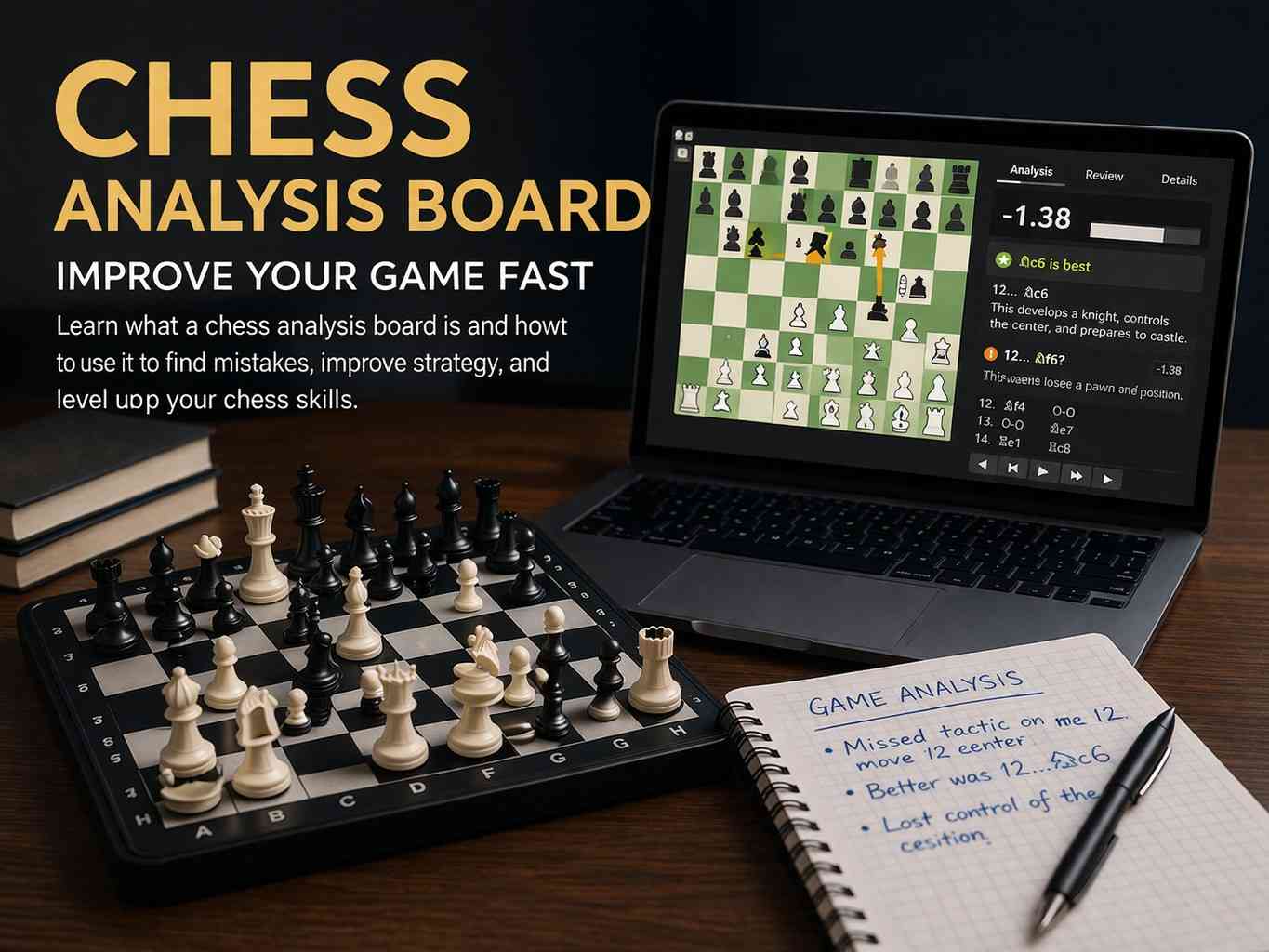
In chess, playing the game is only half the journey.
The real improvement begins after the game ends.
That’s where a chess analysis board becomes your most powerful tool.
Whether you’re a beginner trying to understand your mistakes or an advanced player refining strategies, a chess analysis board helps you see what you missed, what you could have done better, and how to think more clearly in future games.
In this guide, we’ll break down everything you need to know about chess analysis boards — what they are, how they work, and how you can use them to dramatically improve your skills.
🧠 What Is a Chess Analysis Board?
A chess analysis board is a tool used to review and study chess positions. It allows players to:
- Replay games move by move
- Analyze mistakes and missed opportunities
- Test alternative strategies
- Evaluate positions
Unlike a normal game board, the analysis board is not about playing competitively — it’s about learning and understanding.
🔍 Types of Chess Analysis Boards
There are two main types:
🪵 1. Physical Analysis Board
This is a traditional chessboard used for post-game analysis.
You can:
- Recreate positions from your game
- Try different moves manually
- Visualize strategies
Best for:
- Offline study
- Deep thinking
- Tournament preparation
💻 2. Digital Analysis Board
Online platforms provide advanced analysis boards with powerful features.
These include:
- Move suggestions
- Evaluation scores
- Best move recommendations
- Engine analysis (AI-powered)
Examples include:
- Chess websites and apps
- Training software
Best for:
- Fast learning
- Error detection
- Instant feedback
🎯 Why Chess Analysis Is Important
Many players make the mistake of only playing games without reviewing them.
That’s like practicing without learning.
Here’s why analysis matters:
🔥 1. Learn from Mistakes
Every game contains errors — even wins.
Analysis helps you:
- Identify blunders
- Understand why moves failed
- Avoid repeating mistakes
🧩 2. Improve Decision-Making
By reviewing positions, you learn:
- Better move selection
- Pattern recognition
- Strategic thinking
🧠 3. Develop Deeper Understanding
Chess is not just about moves — it’s about ideas.
Analysis teaches:
- Why a move works
- How positions evolve
- What plans to follow
📈 4. Faster Improvement
Players who analyze games improve significantly faster than those who don’t.
⚙️ How a Chess Analysis Board Works
Let’s break it down step by step.
🔹 Step 1: Load or Set Up a Game
You can:
- Enter your game manually
- Import PGN (game file)
- Replay a match
🔹 Step 2: Replay Moves
Go through the game move by move.
Pause and ask:
👉 Why was this move played?
👉 Was there a better option?
🔹 Step 3: Identify Mistakes
Look for:
- Blunders
- Missed tactics
- Poor positioning
🔹 Step 4: Try Alternative Moves
This is where the magic happens ✨
Instead of accepting what happened:
- Try different moves
- Explore variations
- Test new ideas
🔹 Step 5: Use Engine (Optional)
Digital boards use engines (AI) to:
- Suggest best moves
- Evaluate positions (+/- score)
But don’t rely blindly — understand the reasoning.
🧠 How to Use a Chess Analysis Board Effectively
Using the board is easy. Using it correctly is the real skill.
✔ Focus on Critical Moments
Don’t analyze every move equally.
Focus on:
- Turning points
- Blunders
- Key decisions
✔ Ask Questions
Instead of memorizing moves, ask:
- What was my plan?
- What was my opponent’s plan?
- What did I miss?
✔ Analyze Without Engine First
Try to think on your own before using AI.
This improves your thinking ability.
✔ Take Notes
Write down:
- Mistakes
- Lessons learned
- Ideas for improvement
✔ Practice Similar Positions
If you struggle with certain positions:
👉 Practice them repeatedly
⚡ Common Mistakes in Analysis
Even analysis can go wrong if done incorrectly.
❌ Only Checking Engine Moves
Many players just follow AI suggestions without understanding.
👉 Result: No real improvement
❌ Ignoring Your Own Thinking
Your goal is to improve your brain, not rely on software.
❌ Skipping Analysis After Wins
Winning doesn’t mean perfect play.
You can still learn a lot.
❌ Rushing Through Analysis
Take your time. Quality matters more than speed.
🧩 Key Features of Digital Analysis Boards
Modern tools come with powerful features:
📊 Evaluation Bar
Shows who is winning and by how much.
💡 Best Move Suggestions
Recommends optimal moves.
🔄 Move Variations
Explore different possibilities.
📁 Game Storage
Save and review games anytime.
🎯 Who Should Use a Chess Analysis Board?
👉 Beginners — to learn fundamentals
👉 Intermediate players — to fix mistakes
👉 Advanced players — to refine strategy
👉 Coaches — to teach students
In short: everyone who wants to improve
🔥 Benefits of Using a Chess Analysis Board
- Faster skill improvement
- Better understanding of positions
- Stronger tactical awareness
- Improved strategic planning
- Reduced mistakes over time
🧠 Real Example (Simple Idea)
Let’s say you lost a game.
Instead of moving on:
- Load the position
- Find where things went wrong
- Try a better move
This one habit can transform your game completely.
🏁 Final Thoughts
A chess analysis board is not just a tool — it’s your personal coach.
It teaches you:
- What went wrong
- What could go right
- How to think better
If you truly want to improve at chess, don’t just play more games.
👉 Analyze them. Learn from them. Grow from them.
♟️ Ready to Improve?
Next time you finish a game:
- Don’t close it
- Don’t forget it
👉 Open your analysis board
👉 Replay your moves
👉 Find your mistakes
Because the real game… begins after the game ends.